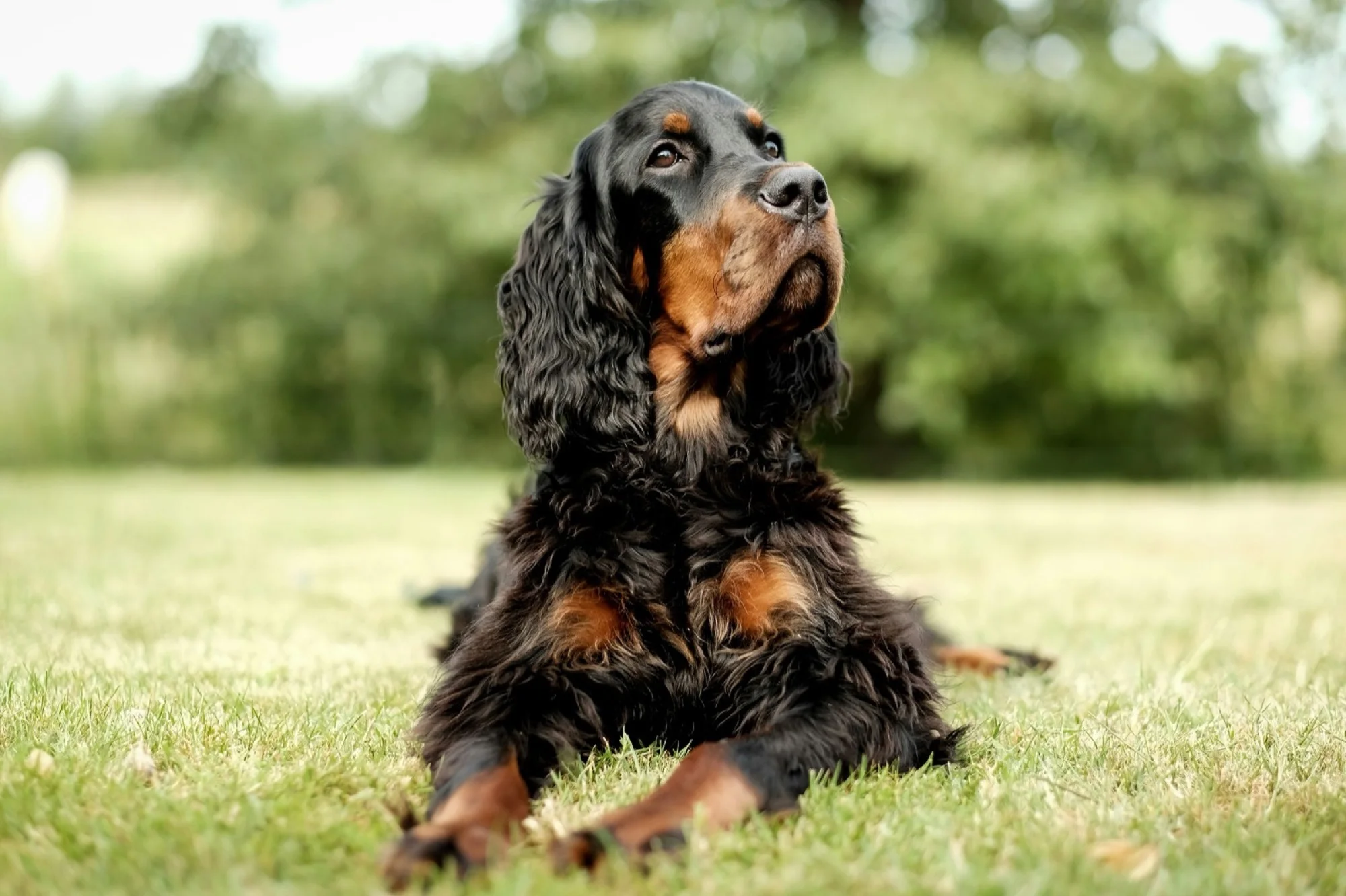
Cocker Spaniel
The UK’s second favourite dog. A nose that never stops. A brain that most owners accidentally ignore.
The UK’s second favourite dog. A nose that never stops. A brain that most owners accidentally ignore.
“Cocker” comes from “woodcock.” These dogs were bred specifically to flush woodcock and other game birds from dense undergrowth, using their nose to locate the bird and then flushing it into the open for the hunter. This required a dog that could work thick cover at speed, follow scent in challenging conditions, and keep going all day without tiring.
The breed splits into two distinct lines: show Cockers (bred for conformation, generally calmer) and working Cockers (bred for field work, significantly more driven). Most pet Cockers in the UK fall somewhere on this spectrum, but even show-line Cockers carry the scent instinct that made the breed.
Cockers were also bred to retrieve shot game, giving them a secondary retrieve drive that combines with their scent work. The result is a dog that wants to find things, pick them up, and bring them back — a natural find-and-retrieve machine that most owners use for nothing more demanding than a tennis ball.
The nose that won’t stop. Every walk becomes a forensic investigation. Every visitor is sniffed exhaustively. Every bag that enters the house is inspected. Your Cocker isn’t being rude — their nose is the primary way they experience the world, and they can’t switch it off.
The bush diving. Cockers disappear into hedgerows, brambles, and undergrowth because that’s exactly what they were bred to do. Calling them out feels impossible because the scent trail in the bush is more compelling than your voice.
The manic energy. Working Cockers in particular have a reputation for being “crazy” — bouncing, spinning, unable to settle. This is usually a scent and retrieve brain that’s chronically under-stimulated. The energy isn’t the problem. The lack of purpose is.
The carrying. Cockers carry things — toys, socks, sticks, random objects from the garden. Like Labs, this is the retrieve instinct looking for a job.
The defining instinct. Cockers are nose-first dogs whose entire working purpose was scent-based. A Cocker’s nose contains approximately 220 million olfactory receptors. Most pet Cockers never get structured scent work, which is like owning a racing car and only driving it to the shops.
Strong and cooperative. Cockers retrieve naturally and enthusiastically, with a soft mouth bred for carrying game birds. Retrieve work combined with scent work (hide-and-retrieve games) is the sweet spot for this breed.
Present and meaningful. Cockers flush game by chasing it from cover, so the chase instinct is part of their flushing behaviour. This shows up as a love of pursuit games and a tendency to bolt after birds and squirrels.
Moderate but important. Cockers are clever dogs that benefit from cognitive challenges, particularly when combined with scent work.
Minimal.
Some Cockers dig, particularly when following underground scent trails, but it’s not a primary drive.
instinct prescribes a scent-heavy daily programme that works the Cocker’s nose the way it was built to be worked. A typical week might include: a scent trail laid through the house or garden using food or a scented article, a scatter feed in long grass that turns a meal into a foraging game, a find-and-retrieve combining hidden objects with delivery, a box search where the dog identifies which of several boxes contains the hide, and a “which hand?” discrimination game that builds scent precision.
The transformation in a Cocker that starts regular scent work is one of the most dramatic of any breed. The manic energy settles. The recall improves (because the nose has been satisfied). The settling at home becomes possible. It’s not a different dog — it’s the same dog, finally getting what it needs.
The Duke and Duchess of Cambridge’s black working Cocker Spaniel was one of the most famous dogs in Britain. He appeared in the family’s official photos and was reportedly Prince George’s constant companion.
“Spaniel” likely derives from “Espagnol” (Spanish), as the breed type may have originated in Spain before being developed in England. “Cocker” specifically refers to their use in hunting woodcock.
Working and show Cockers are so different in temperament and build that many people mistake them for different breeds entirely.
Cockers are increasingly used as detection dogs by UK police forces and Border Force. Their size, drive, and nose make them ideal for searching vehicles, luggage, and buildings.
Cockers were the UK’s second most registered breed in 2024. That’s roughly 63 new Cocker puppies registered every single day.
Join the waitlist and be first to unlock your Cocker’s instinct profile when instinct launches.
No spam. Just one email when we launch. Unsubscribe anytime.