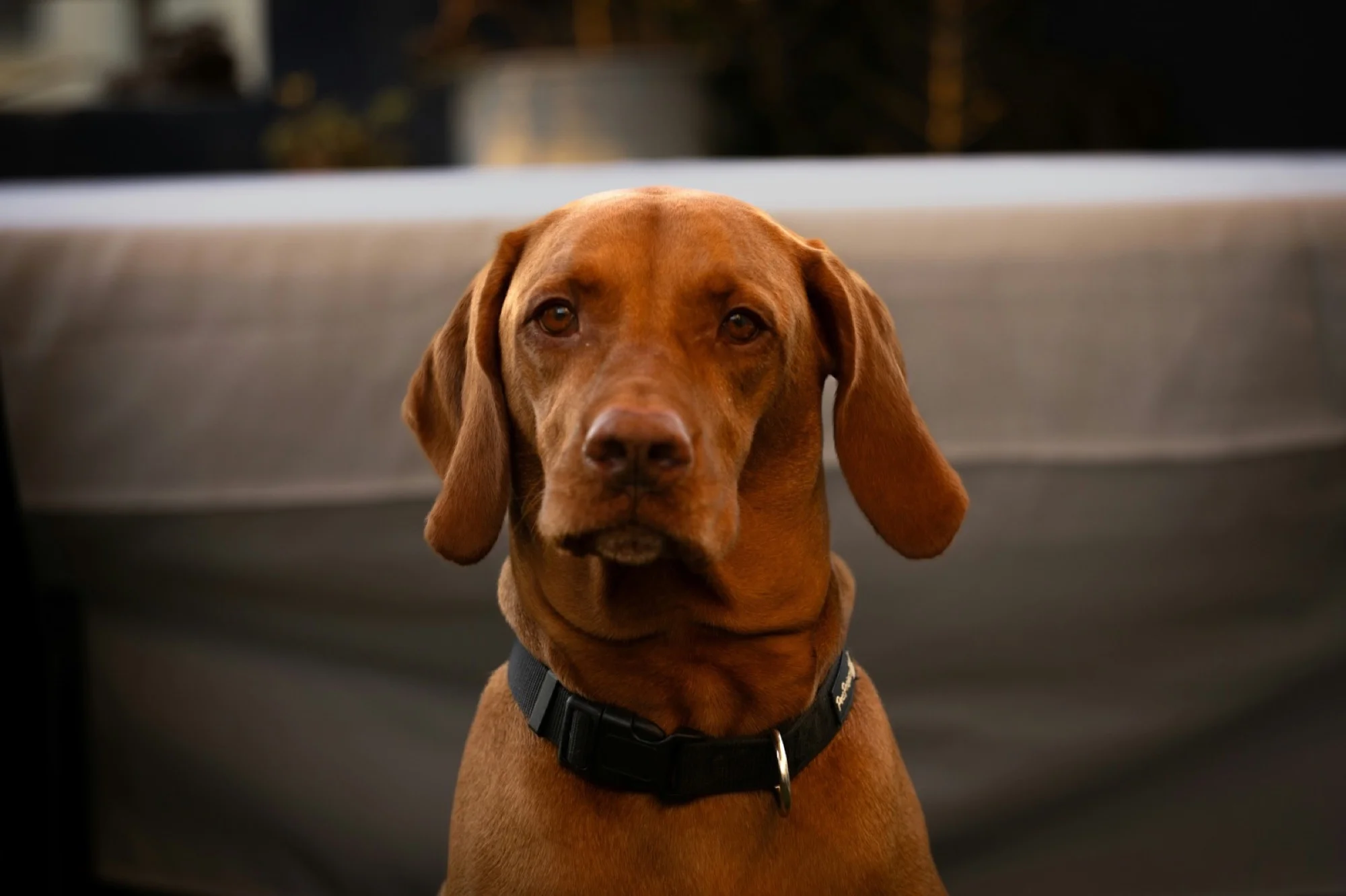
Hungarian Vizsla
The dog that does everything. Points, retrieves, tracks, and then sleeps on your lap. The Vizsla is the ultimate working companion — and utterly lost without a job.
The dog that does everything. Points, retrieves, tracks, and then sleeps on your lap. The Vizsla is the ultimate working companion — and utterly lost without a job.
One of Europe’s oldest sporting breeds, the Vizsla’s history stretches back over a thousand years to the Magyar tribes who settled the Carpathian Basin. These were prized hunting companions of Hungarian nobility — dogs that could point game, retrieve from land and water, and track wounded quarry across varied terrain.
The breed survived against extraordinary odds. During the Ottoman and Soviet occupations of Hungary, dedicated breeders smuggled dogs across borders to preserve the bloodline. The Vizsla exists today because people risked everything to keep it alive.
What makes the Vizsla unique among gun dogs is its extreme handler attachment. Most sporting breeds are bred to work at distance — ranging far ahead, operating independently. Vizslas work close. They check in constantly. They become visibly distressed by separation from their handler. This isn’t a flaw — it’s a feature. The Vizsla was bred to work as a single unit with one human, and that bond runs deeper than almost any other breed.
In a family home, that translates to a dog that is exceptionally loyal and exceptionally needy. Without work to channel that devotion, a Vizsla isn’t just bored — it’s emotionally distressed.
A Vizsla in a family home is a working hunter’s brain wrapped in the most emotionally dependent package you’ll ever encounter. You’ll see it everywhere:
The Velcro factor. This is the definition of a Velcro dog. A Vizsla will follow you from room to room, lean against your legs, rest its head on your lap, and watch you with an intensity that borders on devotion. That handler-bond is the breed’s greatest gift — but without adequate mental stimulation, it tips into separation anxiety. The same instinct that makes them extraordinary working partners makes them fall apart when left alone with nothing to process.
The athleticism. Vizslas are among the most athletic breeds alive. They’re built for endurance and speed in equal measure, and they can run for hours without tiring. But here’s what most owners miss: physical exercise alone doesn’t tire a Vizsla, because the working brain needs a cognitive component. A Vizsla that runs five miles and then destroys your sofa isn’t under-exercised — it’s under-stimulated.
The sensitivity. Vizslas are emotionally attuned to their handler’s mood, tone, and body language to a degree that can be startling. Raise your voice and a Vizsla will shut down. Change your routine and a Vizsla will notice before you do. This is sophisticated social intelligence — the same attunement that makes them brilliant working dogs makes them vulnerable to stress in a chaotic household.
The pointing. Even pet Vizslas still point instinctively — freezing mid-stride, one paw raised, body rigid, locked onto a scent or movement. It’s ancient hunting software running unbidden, and it’s a vivid reminder of the working dog that lives inside every Vizsla, regardless of whether it’s ever seen a field.
Vizslas are tracking dogs with an excellent nose. The pointing behaviour that defines the breed is scent-triggered — they locate quarry by nose, then freeze to indicate its position. In a pet home, scent work is the single most effective way to engage the Vizsla brain. It draws on the deepest instinct in their repertoire.
A strong pursuit drive inherited from centuries of hunting. Vizslas chase with speed and determination — once locked onto a moving target, they’re committed. In the field, this follows the point: locate, freeze, then pursue on command. In a pet home, it means squirrels, rabbits, and anything that moves fast will trigger an instinct that predates obedience training by a thousand years.
Natural retrievers. Vizslas are cooperative, willing, and enthusiastic about bringing things back — from land and water alike. They’re true all-terrain gun dogs, as comfortable retrieving from a lake as from a stubble field. The retrieve is deeply satisfying for a Vizsla because it combines physical work with handler interaction — the two things they crave most.
Intelligent, responsive, and quick learners who thrive on variety and novelty. Vizslas don’t have the obsessive problem-solving drive of a Border Collie, but they’re sharp, adaptable, and become frustrated quickly if things are too repetitive. They need new challenges regularly to stay engaged.
Minimal. Vizslas are gun dogs, not herders. You won’t see significant herding or spatial control behaviours.
Minimal. Digging isn’t a primary instinct in this breed.
instinct prescribes a daily mission that mirrors the Vizsla’s natural hunting sequence: scent, locate, point (impulse control), pursue, retrieve, deliver. Each session draws from all three primary instincts — scent, chase, and retrieve — in a structured sequence that satisfies the working brain without requiring a Hungarian grouse moor.
Pre-departure enrichment is particularly important for this breed. A ten-minute scent game before leaving the house gives a separation-prone brain something to process — dramatically reducing the anxiety that builds when a bonded Vizsla is left with nothing but an empty room and a closed door.
Ten minutes. One activity. Calibrated to the instinct mix that makes your Vizsla a Vizsla.
The word “vizsla” is thought to derive from a root meaning “to seek” or “to search” — an apt name for a breed whose entire purpose is finding things.
Fewer than a dozen documented purebred Vizslas remained after the Second World War. The breed was saved by expatriate Hungarians who smuggled dogs out of the country before the Soviet occupation sealed the borders. Every Vizsla alive today descends from that handful of survivors.
Vizsla puppies as young as eight weeks have been documented pointing at birds, insects, and scents without any training whatsoever. The behaviour is completely hardwired — ancient software that runs the moment the hardware is switched on.
Former White House Press Secretary Dana Perino’s Vizsla, Jasper, became one of the most famous dogs in American politics and inspired a bestselling book. Proof that even in the corridors of power, a Vizsla will still lean on your legs and follow you everywhere.
UK Kennel Club registrations for the Vizsla have increased dramatically over the past decade, driven largely by the athletic dog lifestyle trend. Many owners are drawn to the breed’s running ability but underestimate the cognitive needs that come with it.
The Vizsla is one of the few breeds where the same individual dogs compete in both field trials and conformation shows — because the breed standard has maintained a genuine working physique rather than splitting into show and working lines.
No spam. Just one email when we launch. Unsubscribe anytime.