Scent
Track, find, discriminate.
The most powerful sense your dog has — and the most under-used.
The most powerful sense your dog has — and the most under-used.
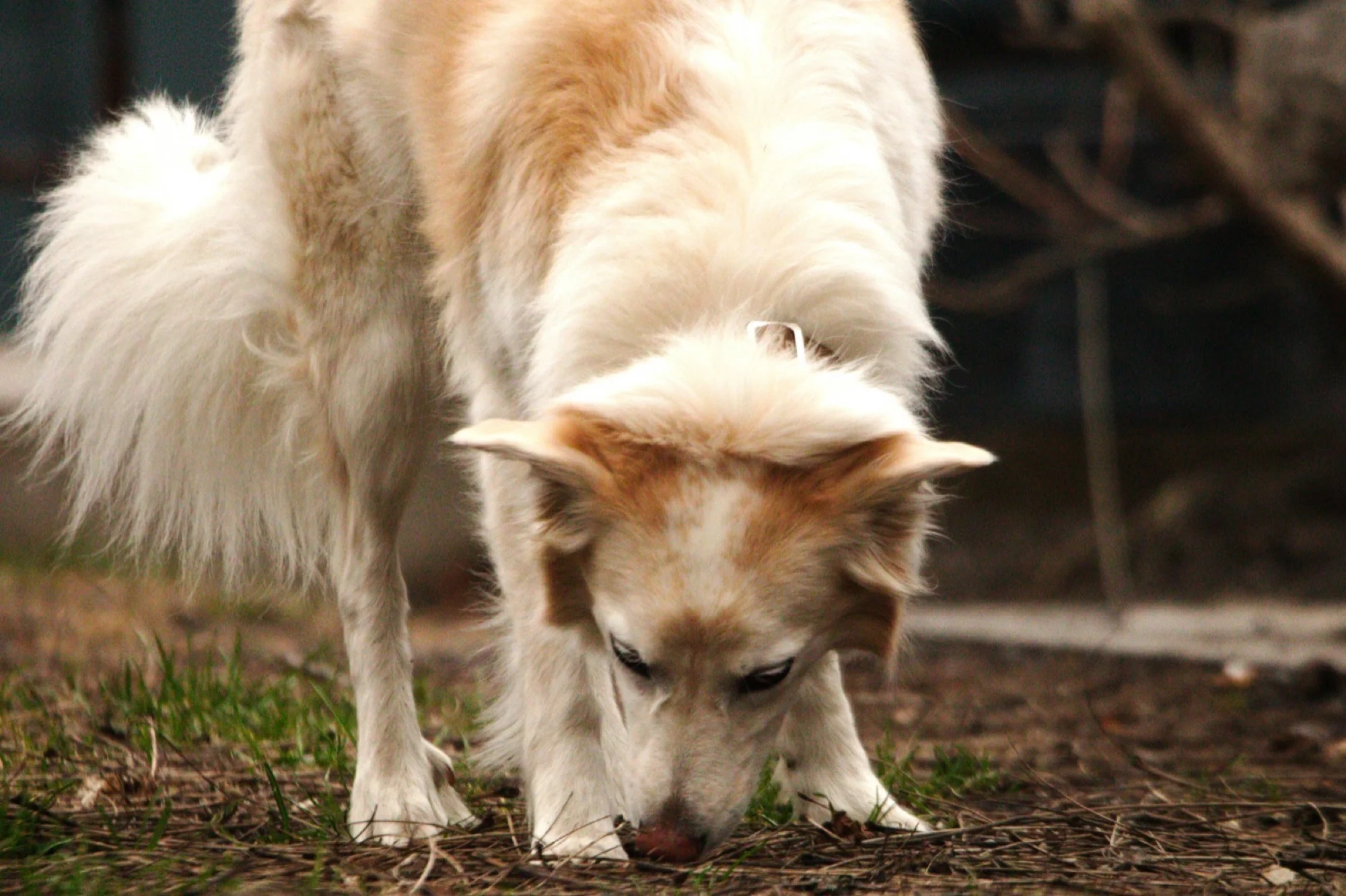
Your dog’s nose is extraordinary. While you experience the world through your eyes, your dog experiences it through 300 million olfactory receptors — roughly fifty for every one of yours. When a scent-driven dog puts their nose to the ground, they’re not just smelling something. They’re reading a story: who was here, how long ago, which direction they went, and what mood they were in.
The Scent instinct is the drive to track, locate, and differentiate between odours. It’s the engine behind flushing, trailing, detection work, and search and rescue. For centuries, humans selectively bred dogs to refine this ability — creating breeds whose entire purpose was to follow their nose across miles of terrain, through water, underground, and in conditions where human senses are useless.
Today, most scent-driven dogs live in houses where the most complex olfactory challenge they face is the bin lid. Their noses are switched on 24/7 with nothing meaningful to do. That’s not a design flaw. It’s a fulfilment gap.
Bred to flush game from dense cover using scent alone. Their nose works constantly on walks — not because they’re being difficult, but because that’s literally what they were designed to do.
Compact flushing dogs with a nose that rivals much larger breeds. The UK’s second most popular breed, and one of the most chronically under-stimulated because owners underestimate how scent-driven they are.
Scenthounds bred to track hare in packs for hours. A Beagle’s nose overrides almost everything, which is why recall can feel impossible — they’re following a scent trail that’s more compelling than your voice.
The gold standard. Bred to track human scent over distances of 130+ miles and across terrain days old. Their nose contains 230 million scent receptors.
Originally bred to work with fishermen and later as gun dogs, Labs have a powerful nose that’s now used in detection work worldwide. Most pet Labs never get to use it.
Versatile hunting dogs bred to point, track, and retrieve using scent. They quarter fields systematically, covering ground with their nose rather than their eyes.
They inherit the spaniel’s nose. If your cross has spaniel in them, scent work isn’t optional enrichment — it’s a core need.
You’ll recognise the Scent instinct in your dog if they:
If your dog’s nose hits the ground the moment you open the front door, you’re living with a scent-driven brain.
A scent-driven dog that never gets to use its nose properly doesn’t just miss out on fun — it develops compensatory behaviours. Counter-surfing. Bin-raiding. Eating things off the pavement. Pulling relentlessly on the lead because every walk is a frustrating buffet of scents they can’t properly investigate.
The “selective deafness” that owners of Beagles and Spaniels joke about? That’s often a scent-driven brain that’s so understimulated it goes into overdrive the moment it gets outside. The nose takes over because it’s been starving all day.
Recall problems, lead reactivity, and destructive foraging at home are frequently symptoms of a scent instinct that has nowhere to go.
instinct prescribes daily scent-based activities calibrated to your dog’s breed mix. Not generic “hide a treat” suggestions — structured scent challenges that progress in complexity as your dog develops.
Foundation activities might include simple scatter feeds in the garden, towel wraps with hidden kibble, or “find it” games with food placed around the house. Intermediate challenges introduce scent trails laid across different surfaces, box searches with multiple hides, and discrimination games where your dog learns to find a specific scent among distractors. Advanced work mirrors the foundations of competitive scent work — longer trails, blind hides, and multi-room searches.
Ten minutes of structured scent work tires a spaniel’s brain faster than a 45-minute walk. That’s not a guess. That’s what the science of canine enrichment consistently shows.
Here’s what a scent-focused day might look like in the app.
Handful of kibble or small treats
6–8 cardboard boxes, a few high-value treats
Strong-smelling treats (cheese, liver), a stick or spoon
Join the waitlist and be first to unlock your dog’s scent profile when instinct launches.
No spam. Just one email when we launch. Unsubscribe anytime.