Retrieve
Find, carry, deliver.
A cooperative instinct that bonds dog and handler — and the reason your Lab brings you everything it finds.
A cooperative instinct that bonds dog and handler — and the reason your Lab brings you everything it finds.
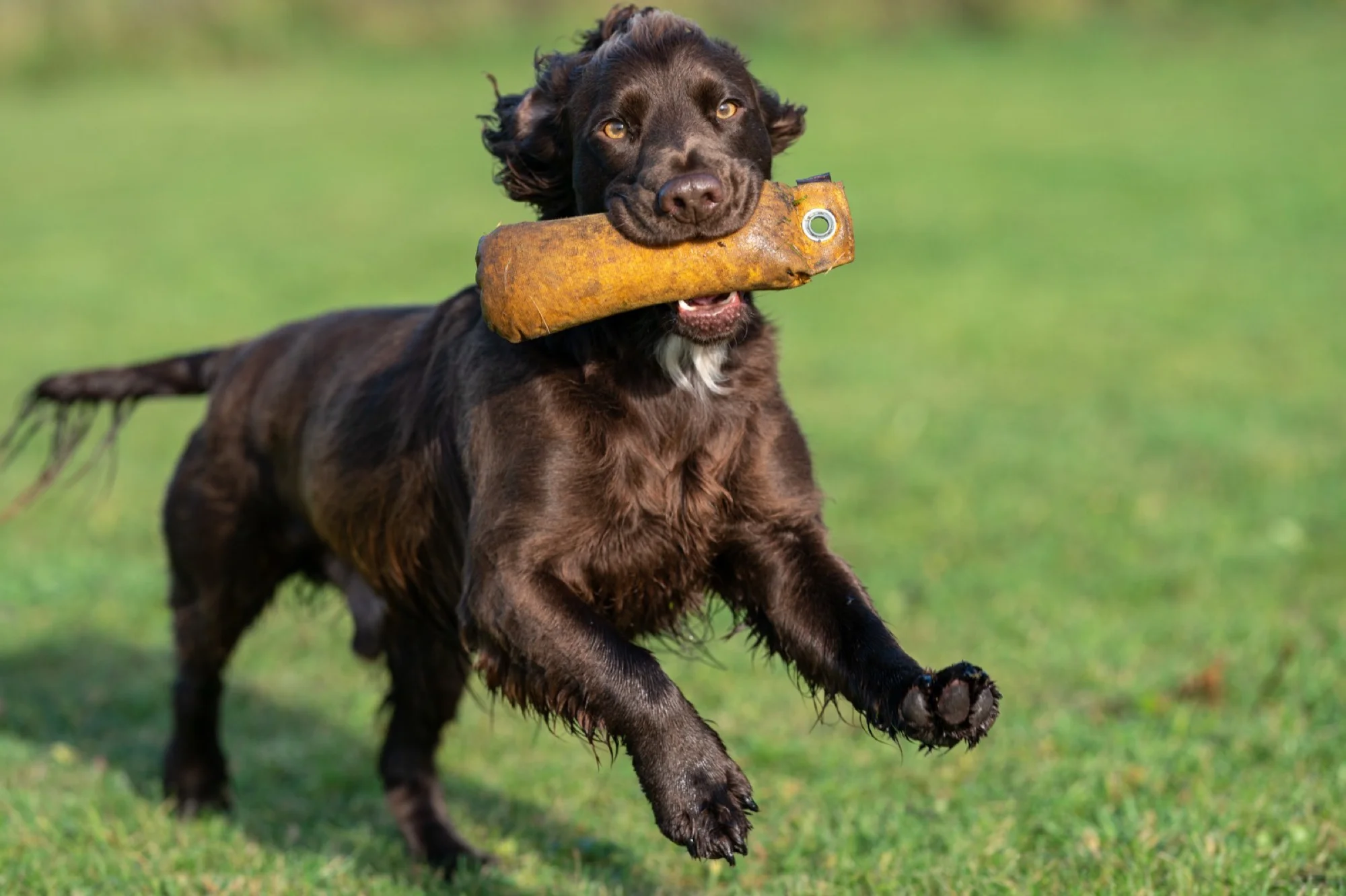
Retrieval is a collaborative instinct. Unlike chase (which is self-rewarding), retrieve involves finding something, picking it up, carrying it, and delivering it back to a handler. It requires impulse control (don’t eat the bird), a soft mouth (don’t damage it), and a willingness to cooperate. It’s one of the most social instincts in any breed — a genuine partnership behaviour.
Gun dog breeds were developed to work alongside hunters, retrieving shot game from land and water. This required stamina, a love of water, biddability, and an almost obsessive desire to carry things in their mouth. The classic image of a Labrador gently holding a duck is centuries of selective breeding in a single moment.
The retrieve instinct shows up as a need to find things, carry things, and bring things to people. It’s why your Lab greets visitors with a shoe in its mouth. It’s why your Golden Retriever collects every stick on the walk. It’s not misbehaviour — it’s a deep-rooted cooperative drive looking for a purpose.
The UK’s most popular breed and arguably the definitive retriever. Bred to haul nets for fishermen and later to retrieve game in freezing water. There are over a million Labs in the UK, and most never retrieve anything more demanding than a tennis ball.
Patient, soft-mouthed, and bred to retrieve game across varied terrain. Their “carry everything” habit is the retrieve instinct working overtime without direction.
One of the most enthusiastic retrievers, with a youthful energy that lasts well into old age. Needs retrieval work to avoid becoming destructive.
Bred to spring game and then retrieve it. The combination of scent and retrieve instincts makes them natural find-and-return dogs.
Smaller retrievers with a surprisingly strong carry-and-deliver drive. Often overlooked for formal retrieve work because of their size, but they thrive on it.
Bred to lure and retrieve waterfowl. Energetic, focused, and deeply frustrated without retrieval outlets.
The retrieval instinct carries strongly through crosses. If your doodle walks around with toys in its mouth, that’s the retrieve brain at work.
You’ll recognise the Retrieve instinct in your dog if they:
If your dog greets every visitor with an object in their mouth, you’re living with a retrieve-driven brain.
Retrieval is a cooperative instinct, which means unfulfilled retrieve drive doesn’t just affect the dog — it affects the bond. A retriever that never gets to retrieve starts resource guarding (because carrying things is so important, they won’t give them back). They develop compulsive carrying behaviours — picking up everything on walks, stealing household items, hoarding toys.
Without structured retrieval work, the impulse control that makes retrievers such good partners erodes. They start snatching food, grabbing things off surfaces, and losing the “soft mouth” quality that was bred into them. The cooperative instinct curdles into possessive behaviour.
And the classic “Lab problem” — a dog that won’t settle, mouths everything, and bounces off the walls — is almost always a retrieval brain with nothing to retrieve.
instinct prescribes retrieve-based activities that exercise the full sequence: mark (see where it falls), memory (remember the location), go (navigate to it), pick up (with a soft mouth), carry (without dropping or chewing), and deliver (back to the handler).
Foundation activities include simple tosses with delivery cues, “hold” training to build a reliable soft mouth, and two-toy games that teach the swap mechanic. Intermediate challenges introduce blind retrieves (the dog didn’t see where it fell), memory retrieves (multiple marks, retrieve in sequence), and water retrieves for dogs with access to safe water. Advanced work includes direction-handling exercises where the handler guides the dog to unseen retrieves, complex multi-mark sequences, and retrieve-and-scent combinations that layer instincts together.
Retrieval is one of the easiest instincts to fulfil because the dog already wants to do it. They just need structure, progression, and a reason to keep cooperating.
Here’s what a retrieve-focused day might look like in the app.
A soft toy or retrieve dummy
Two identical toys (balls or dummies)
Retrieve dummy or soft toy
Join the waitlist and find out how deep your dog’s retrieve drive really goes.
No spam. Just one email when we launch. Unsubscribe anytime.